
UJ News
Caribbean intellectual Prof David Scott brings Small Axe and big questions to South Africa
This article first appeared in Times Live on 11 August 2025. The Johannesburg Institute for Advanced Study (JIAS) recently hosted one of the Caribbean’s most formidable intellectuals, Prof David Scott, to discuss the postcolonial condition. Scott — professor of anthropology at Columbia University in New York, foundi...
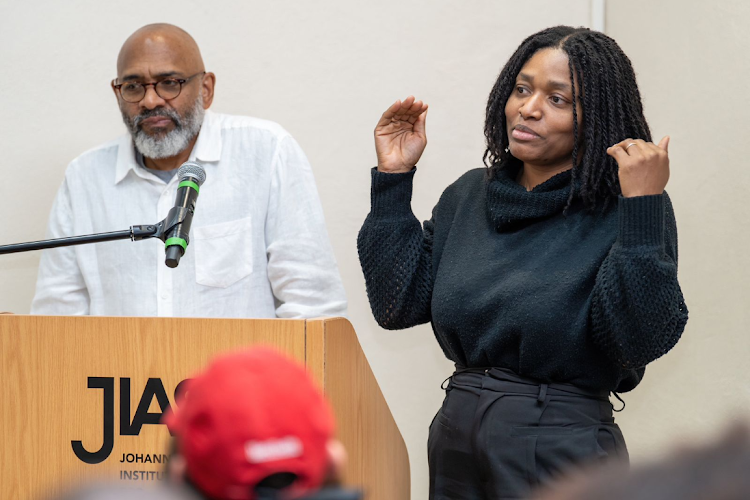
This article first appeared in Times Live on 11 August 2025.
The Johannesburg Institute for Advanced Study (JIAS) recently hosted one of the Caribbean’s most formidable intellectuals, Prof David Scott, to discuss the postcolonial condition.
Scott — professor of anthropology at Columbia University in New York, founding editor of Small Axe, and author of the acclaimed new book Irreparable Evil — is no stranger to South Africa. Last year he delivered the inaugural Walter Rodney Lecture at JIAS. This year he returned with a two-part programme that cuts to the heart of his life’s work: rethinking the postcolonial moment and building spaces for critical dialogue that can last for generations.
For JIAS director Prof Victoria Collis-Buthelezi, his visit embodied the institute’s mission: “We’re here to hold space for scholars from around the world to think with us, challenge us and offer new conceptual languages for grappling with our moment,” she said. “Having David Scott here allows us to do that.”
Scott’s intellectual roots lie in 1970s Jamaica, a period marked by hope and upheaval. He came of age in the shadow of the Caribbean anti-colonial revolutionaries, who were “builders” of the postcolonial state. But his own generation witnessed the ruins: structural adjustment, the collapse of the Grenadian Revolution, debt crises that reshaped entire economies.
Those experiences, said Scott, are not confined to the Caribbean. They speak directly to South Africa’s post-apartheid journey — its struggles over land reform, economic justice, mineral extraction and the meaning of democracy.
“Thinking in and from South Africa with a Caribbean theorist is itself decolonising,” said Collis-Buthelezi. “There’s a shared terrain of experience and struggle, but also different traditions in need of conversation. Our work is to create the platforms where those conversations can happen.”
This year’s centrepiece was The Art of Journal Work: Small Axe at JIAS on August 5, an in-depth exploration of the intellectual and editorial life of one of the world’s most important journals of Caribbean criticism.
The day began with a conversation between Scott and Collis-Buthelezi, tracing the journal’s 30-year history from its birth in the wake of New World Quarterly and Savacou, through its signature use of interviews to its recent editorial shifts.
[perfectpullquote align="right" bordertop="false" cite="" link="" color="" class="" size=""]The work of building a journal is about commitment, rigour and care and making space for voices that might otherwise never be heard. Prof David Scott[/perfectpullquote]
In the afternoon, Small Axe managing editor Prof Vanessa Pérez-Rosario pulled back the curtain on the invisible labour of running a peer-reviewed journal, the submissions, the revisions, the endless attention to detail.
“Part of what Scott allows us to think about is the longevity and sustainability of spaces for criticism,” said Collis-Buthelezi. “Small Axe is a child of Bandung and the solidarity movements of the Global South. Its endurance is a model for holding intellectual ground over decades.”
Institutes for advanced study (IAS) have long been sanctuaries for interdisciplinary and experimental thinking, from Princeton in the 1930s to JIAS today. Johannesburg’s IAS is a unique post-apartheid, pan-African space drawing scholars from around the continent to engage with global thinkers, she said.
“Our city is a place where the legacies of colonialism and capitalism are visible and urgent. Having Scott here means our PhD students, postdocs and colleagues can sit with him, study with him and think with him about what conceptual tools we need for this moment.”